- Page 1
- Page 2
- Page 3
- Page 4
- Page 5
- Page 6
- Page 7
- Page 8
- Page 9
- Page 10
- Page 11
- Page 12
- Page 13
- Page 14
- Page 15
- Page 16
- Page 17
- Page 18
- Page 19
- Page 20
- Page 21
- Page 22
- Page 23
- Page 24
- Page 25
- Page 26
- Page 27
- Page 28
- Page 29
- Page 30
- Page 31
- Page 32
- Page 33
- Page 34
- Page 35
- Page 36
- Page 37
- Page 38
- Page 39
- Page 40
- Page 41
- Page 42
- Page 43
- Page 44
- Page 45
- Page 46
- Page 47
- Page 48
- Page 49
- Page 50
- Page 51
- Page 52
- Page 53
- Page 54
- Page 55
- Page 56
- Flash version
© UniFlip.com
- Page 2
- Page 3
- Page 4
- Page 5
- Page 6
- Page 7
- Page 8
- Page 9
- Page 10
- Page 11
- Page 12
- Page 13
- Page 14
- Page 15
- Page 16
- Page 17
- Page 18
- Page 19
- Page 20
- Page 21
- Page 22
- Page 23
- Page 24
- Page 25
- Page 26
- Page 27
- Page 28
- Page 29
- Page 30
- Page 31
- Page 32
- Page 33
- Page 34
- Page 35
- Page 36
- Page 37
- Page 38
- Page 39
- Page 40
- Page 41
- Page 42
- Page 43
- Page 44
- Page 45
- Page 46
- Page 47
- Page 48
- Page 49
- Page 50
- Page 51
- Page 52
- Page 53
- Page 54
- Page 55
- Page 56
- Flash version
© UniFlip.com
J A N U A RY • F E B R U A RY 2 0 1 5
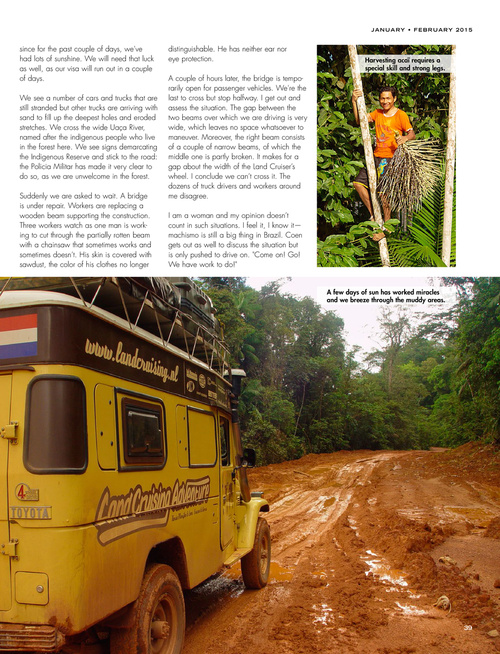
since for the past couple of days, we've had lots of sunshine. We will need that luck as well, as our visa will run out in a couple of days. We see a number of cars and trucks that are still stranded but other trucks are arriving with sand to fill up the deepest holes and eroded stretches. We cross the wide Uaça River, named after the indigenous people who live in the forest here. We see signs demarcating the Indigenous Reserve and stick to the road: the Policia Militar has made it very clear to do so, as we are unwelcome in the forest. Suddenly we are asked to wait. A bridge is under repair. Workers are replacing a wooden beam supporting the construction. Three workers watch as one man is working to cut through the partially rotten beam with a chainsaw that sometimes works and sometimes doesn’t. His skin is covered with sawdust, the color of his clothes no longer
distinguishable. He has neither ear nor eye protection. A couple of hours later, the bridge is temporarily open for passenger vehicles. We're the last to cross but stop halfway. I get out and assess the situation. The gap between the two beams over which we are driving is very wide, which leaves no space whatsoever to maneuver. Moreover, the right beam consists of a couple of narrow beams, of which the middle one is partly broken. It makes for a gap about the width of the Land Cruiser’s wheel. I conclude we can’t cross it. The dozens of truck drivers and workers around me disagree. I am a woman and my opinion doesn’t count in such situations. I feel it, I know it— machismo is still a big thing in Brazil. Coen gets out as well to discuss the situation but is only pushed to drive on. "Come on! Go! We have work to do!"
Harvesting acaï requires a special skill and strong legs.
A few days of sun has worked miracles and we breeze through the muddy areas.
39