- Page 1
- Page 2
- Page 3
- Page 4
- Page 5
- Page 6
- Page 7
- Page 8
- Page 9
- Page 10
- Page 11
- Page 12
- Page 13
- Page 14
- Page 15
- Page 16
- Page 17
- Page 18
- Page 19
- Page 20
- Page 21
- Page 22
- Page 23
- Page 24
- Page 25
- Page 26
- Page 27
- Page 28
- Page 29
- Page 30
- Page 31
- Page 32
- Page 33
- Page 34
- Page 35
- Page 36
- Page 37
- Page 38
- Page 39
- Page 40
- Page 41
- Page 42
- Page 43
- Page 44
- Page 45
- Page 46
- Page 47
- Page 48
- Page 49
- Page 50
- Page 51
- Page 52
- Page 53
- Page 54
- Page 55
- Page 56
- Flash version
© UniFlip.com
- Page 2
- Page 3
- Page 4
- Page 5
- Page 6
- Page 7
- Page 8
- Page 9
- Page 10
- Page 11
- Page 12
- Page 13
- Page 14
- Page 15
- Page 16
- Page 17
- Page 18
- Page 19
- Page 20
- Page 21
- Page 22
- Page 23
- Page 24
- Page 25
- Page 26
- Page 27
- Page 28
- Page 29
- Page 30
- Page 31
- Page 32
- Page 33
- Page 34
- Page 35
- Page 36
- Page 37
- Page 38
- Page 39
- Page 40
- Page 41
- Page 42
- Page 43
- Page 44
- Page 45
- Page 46
- Page 47
- Page 48
- Page 49
- Page 50
- Page 51
- Page 52
- Page 53
- Page 54
- Page 55
- Page 56
- Flash version
© UniFlip.com
T OYO TA T R A I L S
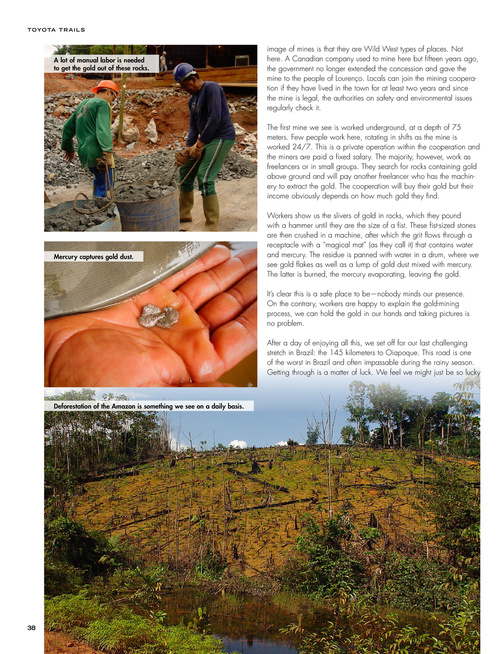
A lot of manual labor is needed to get the gold out of these rocks.
image of mines is that they are Wild West types of places. Not here. A Canadian company used to mine here but fifteen years ago, the government no longer extended the concession and gave the mine to the people of Lourenço. Locals can join the mining cooperation if they have lived in the town for at least two years and since the mine is legal, the authorities on safety and environmental issues regularly check it. The first mine we see is worked underground, at a depth of 75 meters. Few people work here, rotating in shifts as the mine is worked 24/7. This is a private operation within the cooperation and the miners are paid a fixed salary. The majority, however, work as freelancers or in small groups. They search for rocks containing gold above ground and will pay another freelancer who has the machinery to extract the gold. The cooperation will buy their gold but their income obviously depends on how much gold they find. Workers show us the slivers of gold in rocks, which they pound with a hammer until they are the size of a fist. These fist-sized stones are then crushed in a machine, after which the grit flows through a receptacle with a “magical mat” (as they call it) that contains water and mercury. The residue is panned with water in a drum, where we see gold flakes as well as a lump of gold dust mixed with mercury. The latter is burned, the mercury evaporating, leaving the gold. It’s clear this is a safe place to be—nobody minds our presence. On the contrary, workers are happy to explain the gold-mining process, we can hold the gold in our hands and taking pictures is no problem. After a day of enjoying all this, we set off for our last challenging stretch in Brazil: the 145 kilometers to Oiapoque. This road is one of the worst in Brazil and often impassable during the rainy season. Getting through is a matter of luck. We feel we might just be so lucky
Mercury captures gold dust.
Deforestation of the Amazon is something we see on a daily basis.
38