- Page 1
- Page 2
- Page 3
- Page 4
- Page 5
- Page 6
- Page 7
- Page 8
- Page 9
- Page 10
- Page 11
- Page 12
- Page 13
- Page 14
- Page 15
- Page 16
- Page 17
- Page 18
- Page 19
- Page 20
- Page 21
- Page 22
- Page 23
- Page 24
- Page 25
- Page 26
- Page 27
- Page 28
- Page 29
- Page 30
- Page 31
- Page 32
- Page 33
- Page 34
- Page 35
- Page 36
- Page 37
- Page 38
- Page 39
- Page 40
- Page 41
- Page 42
- Page 43
- Page 44
- Page 45
- Page 46
- Page 47
- Page 48
- Page 49
- Page 50
- Page 51
- Page 52
- Page 53
- Page 54
- Page 55
- Page 56
- Flash version
© UniFlip.com
- Page 2
- Page 3
- Page 4
- Page 5
- Page 6
- Page 7
- Page 8
- Page 9
- Page 10
- Page 11
- Page 12
- Page 13
- Page 14
- Page 15
- Page 16
- Page 17
- Page 18
- Page 19
- Page 20
- Page 21
- Page 22
- Page 23
- Page 24
- Page 25
- Page 26
- Page 27
- Page 28
- Page 29
- Page 30
- Page 31
- Page 32
- Page 33
- Page 34
- Page 35
- Page 36
- Page 37
- Page 38
- Page 39
- Page 40
- Page 41
- Page 42
- Page 43
- Page 44
- Page 45
- Page 46
- Page 47
- Page 48
- Page 49
- Page 50
- Page 51
- Page 52
- Page 53
- Page 54
- Page 55
- Page 56
- Flash version
© UniFlip.com
J A N U A RY • F E B R U A RY 2 0 1 5
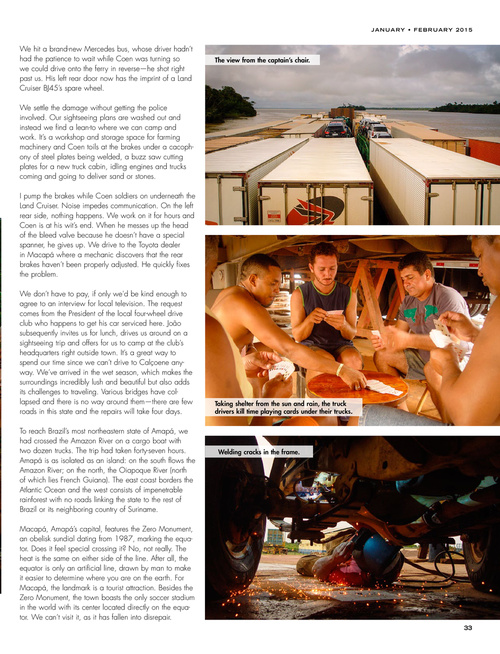
We hit a brand-new Mercedes bus, whose driver hadn’t had the patience to wait while Coen was turning so we could drive onto the ferry in reverse—he shot right past us. His left rear door now has the imprint of a Land Cruiser BJ45’s spare wheel. We settle the damage without getting the police involved. Our sightseeing plans are washed out and instead we find a lean-to where we can camp and work. It’s a workshop and storage space for farming machinery and Coen toils at the brakes under a cacophony of steel plates being welded, a buzz saw cutting plates for a new truck cabin, idling engines and trucks coming and going to deliver sand or stones. I pump the brakes while Coen soldiers on underneath the Land Cruiser. Noise impedes communication. On the left rear side, nothing happens. We work on it for hours and Coen is at his wit’s end. When he messes up the head of the bleed valve because he doesn’t have a special spanner, he gives up. We drive to the Toyota dealer in Macapá where a mechanic discovers that the rear brakes haven’t been properly adjusted. He quickly fixes the problem. We don’t have to pay, if only we'd be kind enough to agree to an interview for local television. The request comes from the President of the local four-wheel drive club who happens to get his car serviced here. João subsequently invites us for lunch, drives us around on a sightseeing trip and offers for us to camp at the club’s headquarters right outside town. It’s a great way to spend our time since we can’t drive to Calçoene anyway. We’ve arrived in the wet season, which makes the surroundings incredibly lush and beautiful but also adds its challenges to traveling. Various bridges have collapsed and there is no way around them—there are few roads in this state and the repairs will take four days. To reach Brazil’s most northeastern state of Amapá, we had crossed the Amazon River on a cargo boat with two dozen trucks. The trip had taken forty-seven hours. Amapá is as isolated as an island: on the south flows the Amazon River; on the north, the Oiapoque River (north of which lies French Guiana). The east coast borders the Atlantic Ocean and the west consists of impenetrable rainforest with no roads linking the state to the rest of Brazil or its neighboring country of Suriname. Macapá, Amapá’s capital, features the Zero Monument, an obelisk sundial dating from 1987, marking the equator. Does it feel special crossing it? No, not really. The heat is the same on either side of the line. After all, the equator is only an artificial line, drawn by man to make it easier to determine where you are on the earth. For Macapá, the landmark is a tourist attraction. Besides the Zero Monument, the town boasts the only soccer stadium in the world with its center located directly on the equator. We can’t visit it, as it has fallen into disrepair.
The view from the captain’s chair.
Taking shelter from the sun and rain, the truck drivers kill time playing cards under their trucks.
Welding cracks in the frame.
33