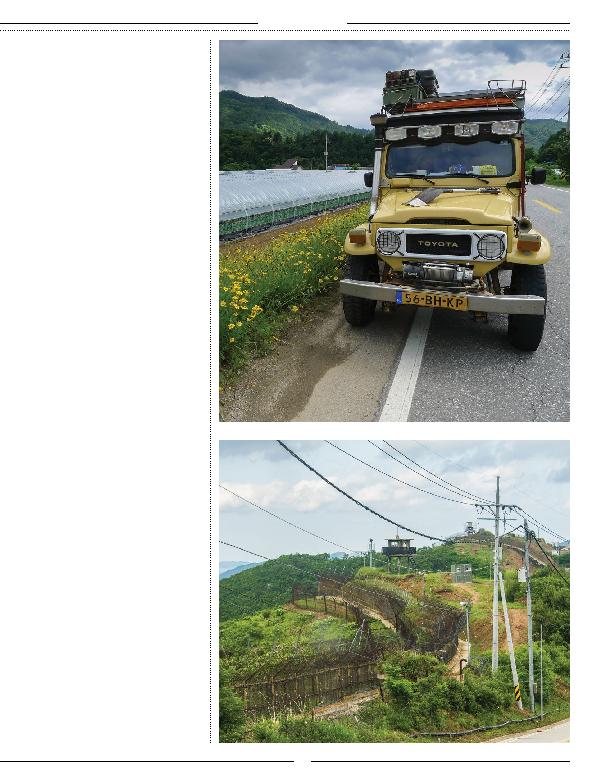
The Demilitarized Zone
North of Yanggu runs the DMZ and
we wanted to see it. However, we had
no idea how close we could get. Most
visitors visit the DMZ directly north of
Seoul, having signed up with a guided
tour from the capital but we were set on
finding another way. We slowly made
our way north and just as we thought
we could reach the buffer zone without
a hiccup, the road was barricaded. A
young soldier emerged from his post
along the side of the road, waving us
to stop as if we had another option. I
rolled down my window.
"Stop," he instructed, making sure we
knew what to do.
His English was minimal and he
was talking about a `pest card'. We
assumed he was talking about a permit
but that's where our understanding
gave out despite efforts on both sides.
A second soldier finally joined the
conversation and explained we had to
return to Yanggu to get a permit. That
sounded easy enough. It was only a
couple of miles driving and at the local
tourist information center, we bought
the permit for a few dollars. Back to
the soldiers. This time they took their
time to jot down in detail what we
looked like and what we were wearing.
"Shoes?" one asked.
"I raised my feet, "Purple flip flops."
He wrote it all down. Were they
afraid we'd try to cross the DMZ into
North Korea?
The barrier was pushed aside and we
drove on, up the hill until we reached
barbed wire. The fence stretched to
hollow, which pinpointed the tunnel.
The construction hadn't been finished
yet and the South Koreans built the
last 765 yards. Halfway, the tunnel
was bricked up and now has a CCTV
system. We sat down in a narrow-gauge
train, rode into the tunnel for a bit
where the soldier explained some more,
talking through a megaphone which
made it impossible to understand one
word. The train turned around and we
exited again, grateful to return to the
fresh air.
TOYOTA TRAILS
25