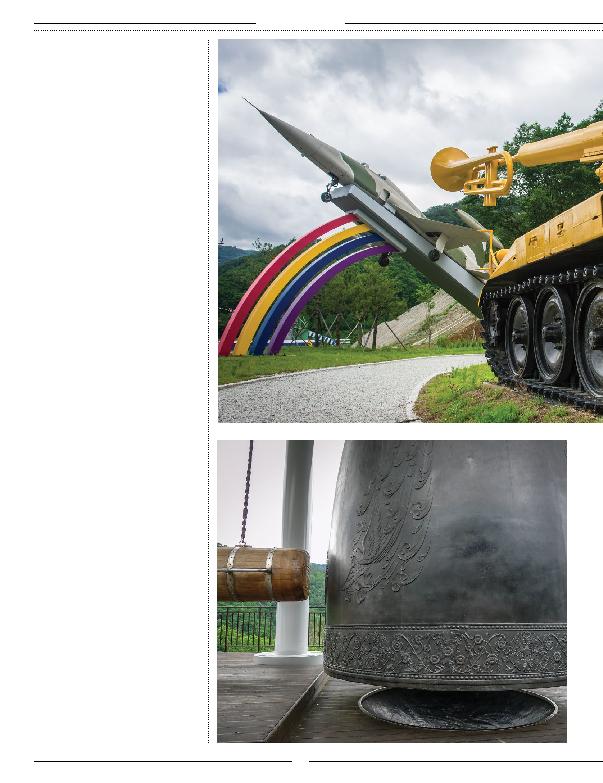
painted tanks. One is tied to the ground
with a thick chain, another has been
transformed into a slide and the barrel
of a third tank has been turned into a
trumpet. On the hill stands the Bell of
Silence. The clock is made of wood and
cannot be rung serving as a symbol
of the two nations that don't talk with
each other.
We couldn't drive across the Peace Dam
due to maintenance but higher up was
another manifestation expressing a wish:
The World Peace Clock. Made in 2008
with shells from thirty conflict zones
in the world it weighs 9,999 gwan (1
gwan = 8.3 lbs). The missing piece lies
in a showcase below the clock with an
explanation saying that when North and
South Korea are reunited, this last piece
will be added to the clock, which will
then weigh exactly 10,000 gwan (about
37.5 tons).
Tunnels Underneath
the DMZ
The aforementioned Imnam Dam was
not the only large-scale infrastructure
project of the North Koreans. South
Korea discovered that their northern
neighbors had dug tunnels underneath
the DMZ. The construction took place
in the 1960-1980s with the intent
of springing a surprise attack. Four
tunnels have been found so far and it
is speculation as to whether there are
more. Depending on the size of the
tunnels, 10,000-30,000 soldiers can
cross per hour and some are big enough
for vehicles. Three of the tunnels are
just north of Seoul and the fourth, only
found in the 1990s, in nearby Yanggu,
is called the Fourth Infiltration Tunnel.
Considering the size of the parking
lot, the site must be packed at times,
probably during weekends or vacations.
During our visit, we were all by
ourselves. We checked out the museum
but all explanatory panels were in
Korean. Outside the museum was
the entrance to the tunnel. A soldier
accompanied us, explaining how the
secret of the tunnel had been revealed
by a defected North Korean soldier.
They found the exact spot by drilling
holes in the mountain until one hit a
TOYOTA TRAILS
22