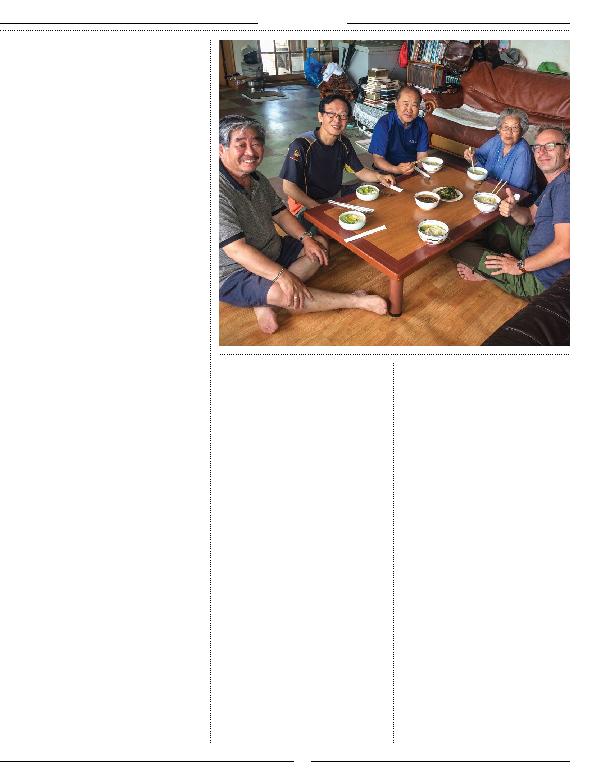
Lunch at Mr. Kim's
The Peace Dam
We were welcomed into a spacious
living room with comfy sofas. The
small coffee table doubled as dinner
table, which is typical for many Korean
homes. During the meal we sat on the
floor or, to be more exact, a linoleum
mat that is electrically heated in winter.
Mr. Kim's wife and mother-in-law
served us noodles, vegetables and
different kinds of kimchi (Korea's staple
of fermented cabbage with red peppers
and other condiments). The visiting
Misters Kim talked about their years in
Germany. One had lived there for forty
years, had flown to South Korea for
a vacation, but continued postponing
his return to Germany. His stay had
grown into three years. Mr. Kim #2
had returned permanently to his home
country after having lived in Germany
for twenty years.
Our conversation was largely in German
until the owner's sisters returned home,
one whom lived in Hawaii, so we
In the 1980s, two years prior to the
Olympic Games in Seoul, the North
Koreans started to build the Imnam
Dam in the Bukhan River just north of
the DMZ. It came with the threat that
this structure would enable North Korea
to destroy a large part of Seoul by means
of a killer flood. South Korea countered
the threat by building the Peace Dam
south of the DMZ in the same river in
order to stop that potential mass of water
from reaching their capital.
The project grew into much more than
a dam. Around the Peace Dam extends
a manifestation of what the South
Koreans (and, I assume, the North
Koreans as well) want: peace. Part of
this is the Peace Art Park with brightly
Nearly half of all Koreans carry the last
name Kim, Lee or Park so when three
men walked up to the Land Cruiser and
they all introduced themselves as Mr.
Kim, we were not surprised. The chat
took place along a reservoir, northeast
of Seoul where we were camped for the
night. We had woken to the deafening
sound of rain pelting down on the
rooftent and decided to stay for a day so
we didn't have to fold the RTT while it
was soaking wet.
Not long after the weather had cleared,
we heard a knock on the door and Mr.
Kim, Mr. Kim, and Mr. Kim shook
hands with us, curious as to whom
these foreigners might be. The first two
Misters Kim were visiting Mr. Kim #3,
who lived uphill, just down the road. He
had been a successful entrepreneur in
Seoul where he owned a shop and sold
car parts until, one day, he had been fed
up, sold his business and built a house
in the countryside on a hill overlooking
the lake. Here, his family lived mostly
from what they cultivated in their large,
beautiful vegetable garden and orchard.
He asked if we'd like to join them for
lunch at his home. Of course we would!
switched to English. It was an inspiring
and internationally oriented group of
people. We took out our road map and
the Misters Kim indicated minor roads
that would take us to the so-called
Peace Dam, which was on our way to
the Demilitarized Zone. In parting
they handed us a bag of tomatoes and
zucchinis from their garden as well as a
massive bag of popcorn. We enjoyed the
vegetables in the days that followed but
all that popcorn was impossible to eat
and we gave it to a group of gardeners
that were taking a break along the side of
the road.
Early the following morning we packed
up and followed the asphalted road
that meandered through rice paddies,
fields with ginseng and zucchini, and
traversed forests. Main or minor, all
roads in South Korea are paved. Off-
roading is non-existent in this small,
highly developed and densely populated
country. The charm of overlanding for us
lies in driving through lands with totally
different ways of life and fascinating
(historic) cultures. In this region the
accent of our journey lies on the Korean
War and the subsequent and continuous
division of North and South Korea. The
Demilitarized Zone, often shortened
to DMZ, is a 155-mile strip of land
across the Korean peninsula, running
from the Yellow Sea in the west to the
Japanese Sea in the east. It has divided
North and South Korea since the end of
the Korean War in 1953 and serves as a
buffer zone between the two countries. It
is not uncommon to see military vehicles,
including tanks, on the roads.
TOYOTA TRAILS
21